At a Glance
| Factor | Detail |
|---|---|
| Compound | Creatine monohydrate |
| Standard dose | 3–5 g/day (no loading required for longevity purposes) |
| Primary targets | Skeletal muscle, brain, heart, kidneys |
| Mechanism | Regenerates ATP via phosphocreatine shuttle |
| Time to effect | 4–6 weeks for muscle saturation; cognitive effects may appear sooner in deficient states |
| Evidence grade | Strong for muscle; Emerging for cognition and longevity |
| Key interactions | No significant interactions at standard doses; monitor with existing kidney disease |
| Best combined with | Resistance training, CoQ10, magnesium, NAD+ precursors |
For the cognitive and neurological dimension of creatine—including sleep-deprivation neuroprotection, traumatic brain injury recovery, and benefits specific to vegetarians—see Creatine for Brain Health and Cognitive Function.
For a broader view of how muscle strength tracks with mortality risk, grip strength dynamometry is now considered one of the most powerful longevity biomarkers available — more predictive than many blood tests.
Creatine has spent decades pigeonholed as a bodybuilder’s supplement. That framing has done enormous harm to older adults who could benefit most from it. In my clinic, I routinely find that longevity-focused patients — many of whom are diligent about NAD precursors, senolytics, and peptides — have never considered creatine. When we look at the cellular biology of aging, this is a significant oversight.
The evidence for creatine extends well beyond hypertrophy. Phosphocreatine is the primary rapid-energy buffer in both muscle and neural tissue. As we age, intramuscular and intracerebral creatine stores decline, mitochondrial efficiency drops, and the regenerative capacity of ATP falls off — contributing to sarcopenia, cognitive slowing, and fatigue syndromes that are nearly universal in patients over 55. For a complete clinical framework on muscle preservation, see Sarcopenia Prevention: A Physician’s Guide to Preserving Muscle Mass After 40. Addressing this deficit is not optional if we are serious about functional longevity.
The Biology: Why Creatine Matters More With Age
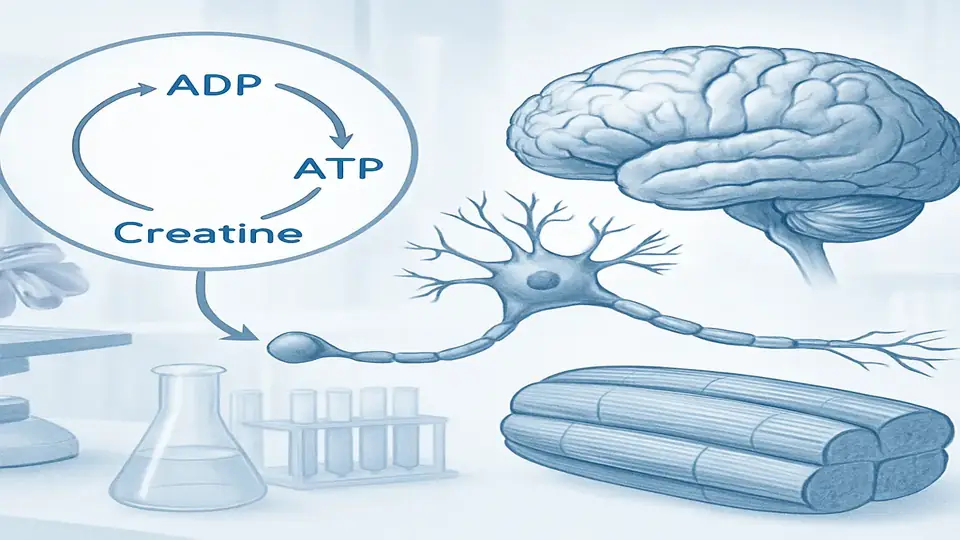
Creatine phosphate (phosphocreatine) acts as a molecular rechargeable battery for cells that require bursts of ATP. When ATP is consumed, creatine kinase catalyzes the transfer of a phosphate group from phosphocreatine back to ADP, restoring ATP within milliseconds. This cycle is fastest in tissue with high and variable energy demands — skeletal muscle, the brain, and the heart.
The problem aging creates is threefold:
- Dietary intake decreases — Most dietary creatine comes from red meat and fish. Older adults with reduced appetite, dietary restrictions, or plant-based eating patterns have systematically lower creatine intake.
- Endogenous synthesis declines — The body synthesizes creatine in the liver and kidneys from arginine and glycine. This synthesis capacity falls with age, compounding dietary shortfalls.
- Mitochondrial coupling efficiency drops — Even when creatine is available, aging mitochondria generate less phosphocreatine per unit of substrate. Exogenous supplementation partially compensates for this by maintaining a higher phosphocreatine pool.
A 2021 analysis in Nutrients found that older adults had intramuscular creatine concentrations roughly 20–25% lower than younger controls when dietary intake was matched — suggesting an intrinsic age-related deficit independent of intake alone.
Sarcopenia Prevention: The Most Under-Used Application
Sarcopenia — the progressive loss of skeletal muscle mass and function with aging — is one of the strongest independent predictors of all-cause mortality and functional decline. It begins around the fourth decade and accelerates after 65. By age 80, the average person has lost 30–40% of peak muscle mass.
The standard of care is resistance training. Creatine does not replace this — but it substantially augments it, and may confer some benefit even without structured exercise.
A 2017 meta-analysis in Medicine & Science in Sports & Exercise pooled 22 randomized controlled trials in older adults and found that creatine supplementation combined with resistance training produced significantly greater gains in lean mass (+1.37 kg), leg press strength (+5.3%), and chest press strength (+5.0%) compared to placebo plus training. These are not trivial numbers in a population where every kilogram of retained muscle correlates with reduced fall risk, better glucose metabolism, and lower mortality.
More relevant to the longevity patient: creatine appears to attenuate muscle protein breakdown (catabolism) during periods of inactivity — illness, hospitalization, injury. This attenuation of catabolic episodes matters enormously for long-term muscle trajectories. A 2020 study in Experimental Gerontology demonstrated that creatine supplementation during short-term immobilization reduced muscle mass loss by approximately 1.1 kg compared to placebo.
For my patients recovering from infection, hyperthermia treatment, or apheresis — periods when activity is necessarily curtailed — ensuring creatine saturation before and during recovery is a practical and evidence-supported intervention.
Cognitive Health: Emerging But Compelling Evidence
The brain, like muscle, is an energetically demanding tissue with limited capacity for energy storage. Neurons rely heavily on phosphocreatine buffering to maintain ATP availability during intense cognitive demand, and creatine transporter expression is high throughout the cortex, hippocampus, and cerebellum.
Several lines of evidence support creatine supplementation for cognitive health:
Vegetarian and vegan populations show the most dramatic cognitive response to creatine supplementation, as they consume essentially no dietary creatine. A landmark 2003 study by Rae et al. in Proceedings of the Royal Society B found significant improvements in working memory and processing speed after 5 weeks of creatine supplementation in vegetarians, with no significant effect in omnivores — suggesting a meaningful intake-dependent effect rather than a pharmacological one.
Sleep deprivation and mental fatigue appear to be conditions where creatine’s cognitive benefits are most detectable. McMorris et al. (2007) showed that creatine supplementation attenuated the cognitive decline induced by 24-hour sleep deprivation — a clinically relevant finding for patients managing complex chronic illness, shift workers, and anyone managing cognitive load on marginal sleep.
Traumatic brain injury and concussion — phosphocreatine depletion is a hallmark of acute neurotrauma. Animal models and early human data suggest creatine supplementation before and after head injury reduces neuronal loss and accelerates recovery. While this is not yet standard of care, the biological rationale is strong enough that I discuss it with patients in high-risk professions or sports.
Post-COVID cognitive impairment (brain fog) — we have observed in our clinic that patients with post-COVID neurological symptoms often have features consistent with mitochondrial dysfunction and bioenergetic deficit. Creatine, alongside NAD+ precursors and photobiomodulation, forms part of our supportive energy-replenishment protocol for these patients.
What creatine does NOT appear to do, based on current evidence, is meaningfully improve memory or cognition in healthy, well-nourished young adults with normal creatine status. That nuance matters for managing patient expectations.
Mitochondrial Synergy: Creatine in the Longevity Stack
In the context of a comprehensive longevity protocol, creatine occupies a complementary niche alongside mitochondrial support compounds. Understanding the interaction is useful:
- CoQ10 (Ubiquinol) operates at the electron transport chain — it is the workhorse of oxidative phosphorylation. Creatine captures the ATP produced and buffers its availability.
- NAD+ precursors (NMN, NR) support NAD-dependent enzymes including sirtuins and PARP, with downstream effects on mitochondrial biogenesis. Creatine and NAD precursors are not redundant — they address different nodes.
- Magnesium is a required cofactor for creatine kinase activity. Magnesium deficiency — extremely common in older adults — blunts the effectiveness of creatine. Ensuring adequacy before or alongside creatine supplementation is clinically important.
- Resistance training remains the most potent stimulus for mitochondrial biogenesis and creatine utilization. Supplementation without any physical stimulus still confers benefit, but the synergy with structured exercise is considerable.
I frequently see patients spending significant sums on exotic peptides or IV therapies while neglecting foundational interventions like creatine, magnesium, and resistance training. The principle I apply in practice: optimize fundamentals before escalating to advanced protocols.
Dosing, Safety, and Practical Considerations
Dosing
For longevity purposes, the loading protocol (20 g/day for 5–7 days) is unnecessary. A simple maintenance dose of 3–5 g of creatine monohydrate daily achieves full muscle saturation within 3–4 weeks and is better tolerated.
Creatine monohydrate is the best-studied, most cost-effective form. Claims for superiority of creatine hydrochloride, buffered creatine, or creatine ethyl ester are not well-supported by head-to-head evidence.
Timing does not matter significantly for longevity applications. Post-workout is marginally favored for muscle uptake in athletes; for general use, any consistent daily timing is sufficient.
Safety
Creatine monohydrate has an exceptionally well-established safety record across more than 30 years of research. Key points:
- Creatinine rise: Creatine supplementation raises serum creatinine — a creatine metabolite — and can be misread as reduced glomerular filtration. Ordering cystatin C alongside creatinine, or using cystatin C-based eGFR formulas, avoids this interpretive artifact.
- Kidney disease: In patients with established chronic kidney disease, I recommend caution and consultation with a nephrologist before initiating supplementation.
- Weight gain: Initial weight gain of 0.5–2 kg within the first 1–2 weeks reflects intracellular water retention in muscle — not fat accumulation. This is mechanistically beneficial (hydrated muscle performs and metabolizes better) but worth flagging to patients.
- GI tolerance: Some patients experience bloating or cramps, typically at higher doses. Spreading the dose across the day or switching to micronized creatine usually resolves this.
There is no credible evidence for harm to kidney or liver function in healthy individuals at standard doses.
Who Benefits Most: A Clinical Stratification
Based on the evidence hierarchy and clinical experience, I stratify creatine benefit expectation as follows:
Highest expected benefit:
- Adults over 60 with sarcopenia risk or documented muscle loss
- Vegetarians and vegans at any age
- Patients recovering from illness, surgery, or prolonged inactivity
- Patients with post-COVID fatigue or brain fog syndrome
- Patients on caloric restriction protocols
- Perimenopausal and postmenopausal women, who face accelerating muscle catabolism alongside reduced baseline creatine stores — see Creatine for Women: Dosage, Hormonal Effects & Clinical Evidence for sex-specific protocols
Moderate expected benefit:
- Adults 40–60 engaged in resistance training who want to optimize muscle preservation
- Patients with chronic fatigue syndromes or documented mitochondrial dysfunction
- Patients with cognitive concerns related to aging or high cognitive load
Lower expected benefit:
- Healthy omnivores under 40 with high meat intake and active training
- Patients not engaged in any physical activity and unwilling to start
This stratification is pragmatic. It does not mean younger or well-nourished patients gain nothing from creatine — it means the magnitude of measurable benefit is smaller and the clinical priority is lower relative to other interventions.
Related Articles
- The Physician Longevity Supplement Stack: What I Actually Take — Full breakdown of the evidence-based supplement stack for longevity, including creatine’s place in the hierarchy.
- CoQ10 and Heart Health: Ubiquinol vs Ubiquinone Explained — How CoQ10 and creatine complement each other in the mitochondrial energy cascade.
- Magnesium for Sleep and Recovery — Magnesium deficiency undermines creatine kinase activity; addressing both together amplifies results.
- NAD+ IV Therapy: What to Expect — Understanding how NAD precursors and creatine target different but synergistic mitochondrial pathways.
- Post-COVID Brain Fog: Mechanisms and Recovery Protocols — Creatine as part of the bioenergetic support approach for persistent post-COVID neurological symptoms.
References
-
Rawson ES, Venezia AC. Use of creatine in the elderly and evidence for effects on cognitive function in young and old. Amino Acids. 2011;40(5):1349-1362. PubMed
-
Candow DG, Chilibeck PD, Forbes SC. Creatine supplementation and aging musculoskeletal health. Endocrine. 2014;45(3):354-361. PubMed
-
Chilibeck PD, Kaviani M, Candow DG, Zello GA. Effect of creatine supplementation during resistance training on lean tissue mass and muscular strength in older adults: a meta-analysis. Open Access J Sports Med. 2017;8:213-226. PubMed
-
Rae C, Digney AL, McEwan SR, Bates TC. Oral creatine monohydrate supplementation improves brain performance: a double-blind, placebo-controlled, cross-over trial. Proc Biol Sci. 2003;270(1529):2147-2150. PubMed
-
McMorris T, Harris RC, Howard AN, et al. Creatine supplementation and cognitive performance in elderly individuals. Neuropsychol Dev Cogn B Aging Neuropsychol Cogn. 2007;14(5):517-528. PubMed
-
Forbes SC, Candow DG, Krentz JR, Roberts MD, Young KC. Changes in fat mass following creatine supplementation and resistance training in adults ≥50 years of age: a meta-analysis. J Funct Morphol Kinesiol. 2019;4(3):62. PubMed
-
Watanabe A, Kato N, Kato T. Effects of creatine on mental fatigue and cerebral hemoglobin oxygenation. Neurosci Res. 2002;42(4):279-285. PubMed
-
Antonio J, Ciccone V. The effects of pre versus post workout supplementation of creatine monohydrate on body composition and strength. J Int Soc Sports Nutr. 2013;10(1):36. PubMed